
Ph.D. Student
Johns Hopkins University
Hi! My name is Henry, I use he/him pronouns, and I do phonetics research! My research tends to probe potential interactions between articulatory characteristics of speech and sociological factors by acoustic analysis with machine learning. I'm also really into music/sound technology!
All my research code is on my GitHub so that AI companies can scrape it it can be adapted for similar work! I feel like phonetics research is just the same three steps most of the time anyway lol
Feel free to reach out if I can help you in literally any way I love to say yes to things
Warning
Problem: The current name of your GitHub Pages repository ("Solution: Please consider renaming the repository to "
http://".
However, if the current repository name is intended, you can ignore this message by removing "{% include widgets/debug_repo_name.html %}" in index.html.
Action required
Problem: The current root path of this site is "baseurl ("_config.yml.
Solution: Please set the
baseurl in _config.yml to "Education
-
 Johns Hopkins UniversityDepartment of Cognitive Science
Ph.D. StudentSep. 2026 - present -
 Macalester CollegeB.A. in Linguistics and Computer ScienceSep. 2022 - May 2026
Honors & Awards
-
The Linguistics Prize for Academic ExcellenceMacalester College Linguistics Department2026
-
The "Weakly Autonomous" AwardMacalester College Computer Science Department2026
Selected Publications (view all )
A Comparative Analysis of Acoustic and Electroglottographic Measures: Insights from Vocal Fold Vibratory Patterns
Henry Heyden
Linguistics Honors Projects 2026
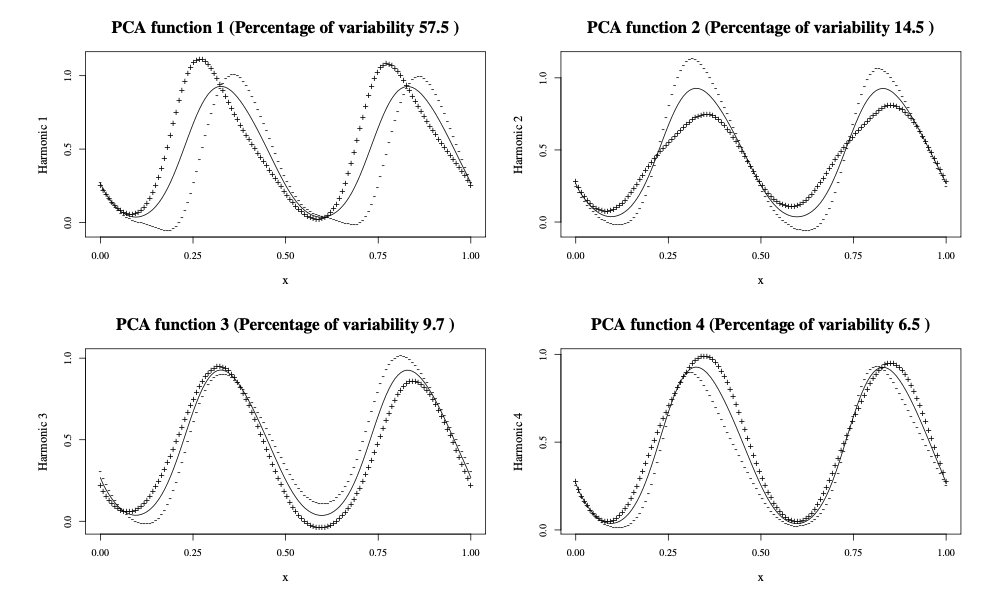
Speakers of languages with phonation contrasts produce voice qualities like "creaky" or "breathy" in different ways. In this project, I used functional principal component analysis to investigate the dominant dimensions of variation in electroglottographic data, in an attempt to further cross-linguistic understanding of non-modal phonation production.
A Comparative Analysis of Acoustic and Electroglottographic Measures: Insights from Vocal Fold Vibratory Patterns
Henry Heyden
Linguistics Honors Projects 2026
Speakers of languages with phonation contrasts produce voice qualities like "creaky" or "breathy" in different ways. In this project, I used functional principal component analysis to investigate the dominant dimensions of variation in electroglottographic data, in an attempt to further cross-linguistic understanding of non-modal phonation production.
Phonetically-Motivated Feature Engineering for Automatic Genre Classification
Capstone Project for Linguistics Major at Macalester College. 2026
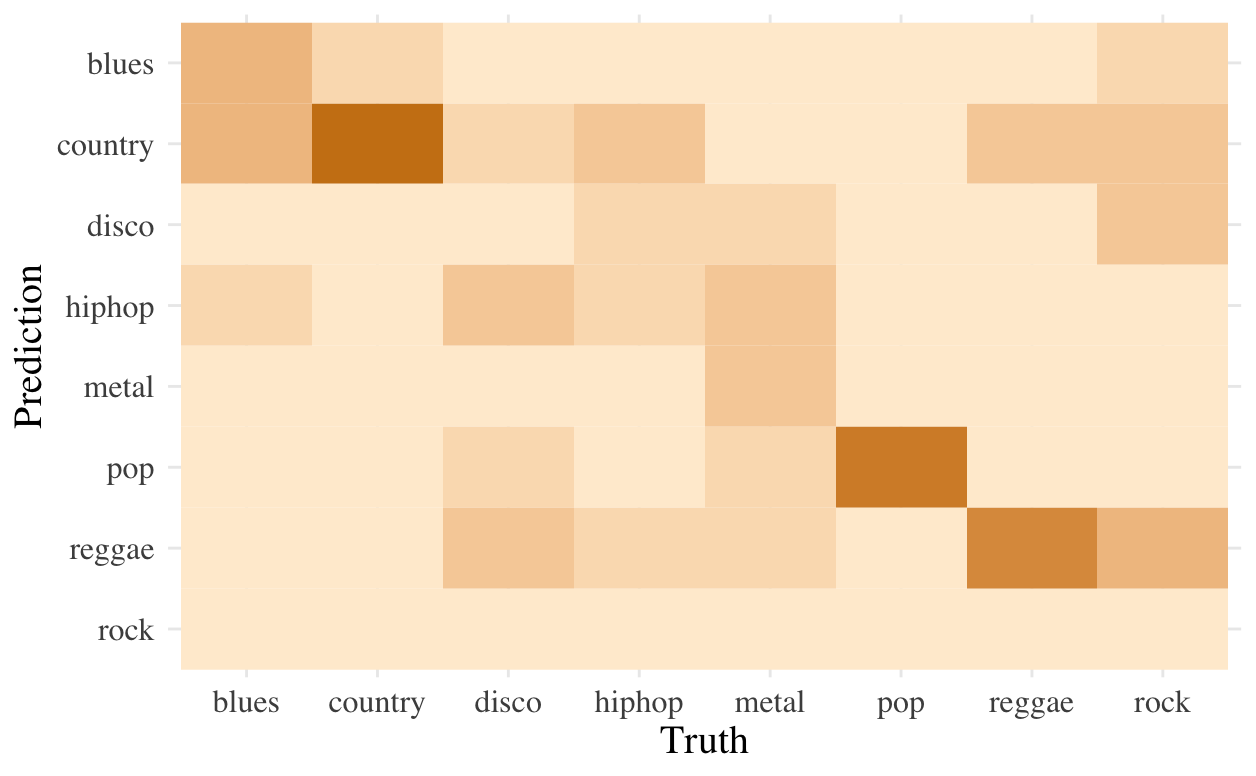
Boundaries between musical boundaries are fuzzy, but certain aspects of vocal performance can effectively index genre (e.g., vibrato in Opera or “rasp” in Country). To probe the salience of these vocal characteristics, I trained a machine learning classifier to predict the genre of a song based solely on acoustic measurements of the lead vocal. A support vector machine reached 45% accuracy on unseen data, and confusion matrices suggested that some genres had more salient voice quality characteristics than others.
Phonetically-Motivated Feature Engineering for Automatic Genre Classification
Capstone Project for Linguistics Major at Macalester College. 2026
Boundaries between musical boundaries are fuzzy, but certain aspects of vocal performance can effectively index genre (e.g., vibrato in Opera or “rasp” in Country). To probe the salience of these vocal characteristics, I trained a machine learning classifier to predict the genre of a song based solely on acoustic measurements of the lead vocal. A support vector machine reached 45% accuracy on unseen data, and confusion matrices suggested that some genres had more salient voice quality characteristics than others.